I spent the day at Mercedes-Benz World in Weybridge with BlakYaks and Microsoft this week. The morning was talks and a fireside panel. The afternoon was a passenger ride in a 600bhp AMG on both dry and wet track, then a go in the F1 and GT simulators.
It was one of those rare events where the venue, the conversation, and the message all pointed at the same thing. Performance is exciting. Performance without control is expensive theatre.
That landed for me before I even got near the track.
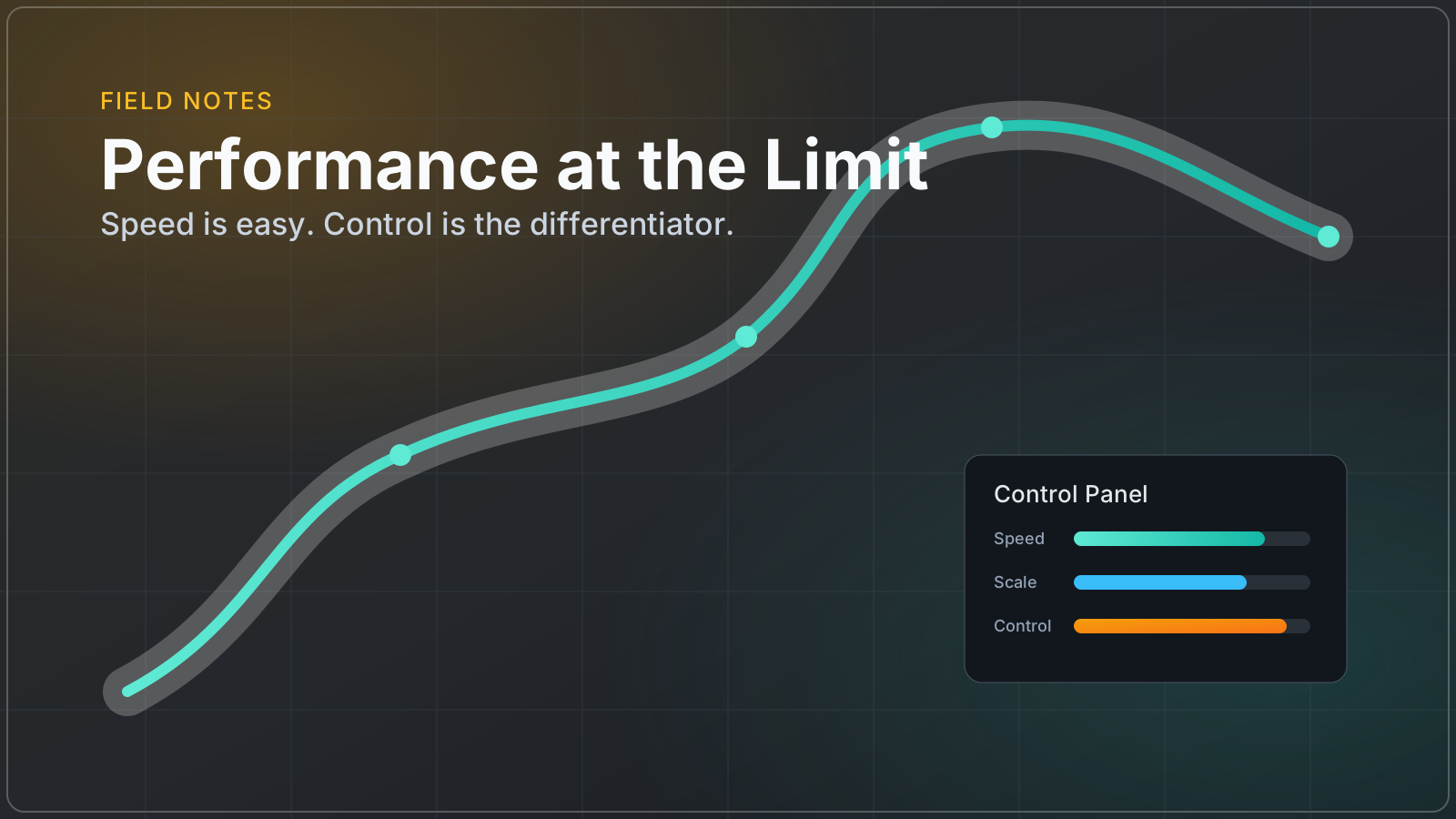
Table of contents
Open Table of contents
The panel
The fireside panel brought together Steve Edwards (Head of Cloud at Close Brothers), John Davidson (Group CIO at First Choice), and Dirk Anderson (CEO of Blakyaks). The most useful parts were not big predictions. They were the operational truths:
- Policy by code
- Self-serve as an operating model, not a slogan
- DevOps as the delivery spine
- The shift from saving money with AI to making money with AI as a way to demonstrate value.
When it came to understanding how we frame different types of AI tooling as they become defacto solutions, one line from the panel has stuck with me:
“We don’t try to calculate the ROI of Word or Excel.”
That is, my mind, the right challenge for leaders. At some point, foundational tooling stops being justified line by line and starts being treated as core infrastructure. AI is moving in that direction, but with a catch: unlike Word and Excel, AI systems can autonomously act, create risk, and generate material cost at speed.
The line lands harder when you look at where the ROI conversation actually sits right now. Last summer, MIT’s NANDA project published The GenAI Divide, and one number did the rounds in every boardroom I know of: 95% of enterprise GenAI pilots delivered no measurable P&L impact, against an estimated $30-40 billion of spend. The methodology took some fair criticism, and I would treat the exact figure as directional rather than gospel, but the shape of the finding matched what I see in the field. High adoption, low transformation. The same study found a thriving shadow AI economy - workers at roughly 90% of the surveyed firms were using personal AI tools daily, while only around 40% of those companies had an official subscription. People are voting with their prompts, and mostly outside governance.
Reading those numbers as an argument for more ROI spreadsheets, is not really the takeaway from my perspective. I read them the other way. Sumit Johar, CIO at BlackLine, put it well when he said that telling your CFO that 95% of employees are using AI means nothing - it is like reporting that all of your employees use email. Usage is not value. Chasing a micro-ROI figure per prompt will not close that gap; it just produces a spreadsheet nobody believes.
So ultimately, we have to stop pretending every AI interaction needs a micro-ROI model. But do not confuse that with “turn it on and hope”. Fund it like infrastructure, then instrument it like production. Infrastructure still needs governance.

The frontier firm model in plain terms
The “Frontier Firm” section delivered by James Lees (Head of Insurance & Investments, Microsoft UK), opened with a line credited to Frank Williams:
Real gains come at the boundary.
That is exactly where most teams are uncomfortable. At the boundary between human judgement and machine execution. Between policy and autonomy. Between possibility and control.
One quote in that section was, for me, the anchor:
Without human direction, you have compute running in circles.
The model presented was clear:
- Human capital and token capital compound together
- Frontier is human-led
- Agentic systems are there to extend judgement, not replace it
Worth knowing where the language comes from. “Frontier Firm” was coined in Microsoft’s 2025 Work Trend Index, which introduced human-agent teams and the slightly awkward job title of “agent boss” for every employee. That report found 81% of leaders expecting agents to be moderately or extensively integrated into their AI strategy within 12 to 18 months. Ambitious. The 2026 follow-up is more sobering: when Microsoft mapped users across individual AI capability and organisational readiness, only 19% landed in the frontier zone. Agent usage in Microsoft 365 grew 15x year on year, so the tooling is arriving; the operating models are what lag behind. That gap between the 81% ambition and the 19% reality is the whole story of enterprise AI in 2026.
The 2026 research also asks three questions that I would now put on the charter of any agentic programme: who reviews agent performance, who has the authority to change the workflows agents run, and how does a local win get captured and scaled? If your organisation cannot answer those in a sentence each, you are running assistants, not agents.
The framework itself was practical.
The four pillars
- Personal productivity
- Innovation (highest risk)
- Business process engineering
- Customer engagement
The three horizons
- Assist
- Automate
- Agentic
The operating spectrum
- Human with assistant
- Human-agent teams
- Human-led, agent-operated
There were also useful signals around implementation direction: Agent 365, Entra Agent ID and managed identity patterns, Copilot control system thinking, and even AI handover concepts when staff offboard.
The Entra Agent ID material deserves a closer look than the slide gave it. In Microsoft’s model, agents become first-class identities in your directory, created from reusable blueprints, subject to Conditional Access and least-privilege permissions like any other principal. Two design decisions stand out. First, every agent identity can carry a named sponsor - a human who is accountable for that agent’s purpose and is the contact point when a security incident happens. Second, lifecycle workflows mean an agent’s access does not persist longer than it is needed. The vendors building a sponsor field into the identity schema tells you something: they already know agents inherit our key-person risk, and they are productising the fix.
That last point matters more than people think, in my view. If your process breaks when one person leaves, you do not have a system. You have a dependency. Agents make that worse, not better, because the person who built and prompted the agent walks out with the context, and the agent keeps running without it.
Speed, scale, control: the right three outcomes
Stuart Anderson (CTO, BlakYaks) framed accelerated AI around three outcomes:
- Delivery speed
- Scale confidence
- Control strength
I like this because it avoids the usual trap of measuring only velocity.
It also matches the best empirical work we have. The 2025 DORA report, drawing on nearly 5,000 technology professionals, lands on a single thesis: AI is an amplifier. It magnifies the strengths of well-run engineering organisations and the dysfunctions of struggling ones. Adoption is no longer the interesting variable - 90% of respondents use AI in their daily work. The interesting variables are the ones underneath: throughput is now positively correlated with AI adoption (a reversal from 2024), but instability rose with it. More change failures. More rework. Faster and more fragile at the same time, because teams adapted for speed while their validation systems stayed human-paced.
Lots of teams are currently reporting “faster” while quietly carrying instability, weak ownership, and opaque model behaviour into production. That is not acceleration. That is deferred failure.
Two other DORA findings are worth holding onto. Around 30% of developers report little or no trust in AI-generated code - which the report’s lead author reads as healthy “trust but verify” scepticism, and I agree, but it also means code review becomes your constraint the moment generation speeds up. And platform quality turned out to be the difference-maker: where internal platform quality is low, AI’s effect on organisational performance is close to negligible; where it is high, the effect is strong and positive. You cannot buy your way past a weak platform with licences.
There is a measurement lesson hiding in here too. METR’s randomised controlled trial from last year found that experienced open-source developers using early-2025 AI tools were 19% slower on tasks in their own repositories - while believing the tools had sped them up by 20%. By February this year, METR reported the picture had likely shifted to a genuine benefit with the newer agentic tools, and that their study design was breaking down partly because developers now refuse to work without AI at all. Take two things from that. Capability is moving fast enough that last year’s evidence has a short shelf life. And self-reported productivity is close to worthless as a signal, which is exactly why the measurement discipline in Stuart’s talk matters:
- MTTR (Mean time to recovery)
- Change failure rate
- Lead time to delivery efficiency
- Toil share and reclaimed engineering capacity
These are measured, not felt. If AI is genuinely improving delivery, these numbers should move in the right direction together over time. If only one number improves, usually speed, then you are not seeing transformation yet. You are seeing a local optimisation.
What motorsport gets right about transformation
Richard West referenced the book Performance at the Limit (co-authors include Prof Mark Jenkins), which felt perfectly placed given where we were - and, in fairness, given who was speaking. West is a co-author of the book alongside Jenkins and Ken Pasternak, after a career on the commercial side of Formula 1 with the McLaren, Williams and Arrows teams. So this was not a speaker borrowing a metaphor. It was someone who had lived inside the case study.
The core idea was simple and sharp: inefficiencies destroy value, and effectiveness multiplied by performance is what counts.
I genuinely think that this equation is worth stealing for AI programmes.
- High performance with weak effectiveness creates expensive noise
- High effectiveness with low performance creates stable stagnation
- You need both, and you need them continuously
Another note from that session was “stable foundation first”. I agree completely, and I push this concept internally that you have to drive innovation from a position of strength as it multiplies what’s there, and if the foundations are weak, that multiplier simple adds to the deficit. You cannot meaningfully scale agentic workflows on top of brittle CI, weak ownership, and unclear service boundaries. DORA’s amplifier finding is the data version of the same point: put horsepower into a well-set-up car and you win; put it into one with a loose rear end and you meet the barrier sooner.
The track experience made the same point physically obvious.
In the wet track section, the driver could still push hard, but every input had to be deliberate. Tiny movements mattered. Over-correct and you lose the line. Under-commit and you lose momentum. On the dry track, the grip was higher, but the fundamentals did not change. Balance, control, and timing still won.
Your AI operating model is the same. More horsepower helps, but only if the chassis can carry it.
Then the F1 and GT simulators drove home something else. Fast laps are not made by one dramatic move. They are made by consistency through every corner. In organisations, that looks like repeatable delivery loops, clear guardrails, and teams that can make quick decisions then learn from outcomes.
That was another line from the day worth keeping: decide quickly, then learn quickly.

Great, so?
If I boil the day down to practical action, this is where I would start.
-
Define your AI operating model explicitly. Decide what sits in assist, automate, and agentic lanes. Assign ownership for each lane and publish it. Then answer Microsoft’s three governance questions in writing: who reviews agent performance, who can change the workflows agents run, and how a local win gets scaled.
-
Move policy into code where possible. If a control matters, make it enforceable in pipeline and platform, not a paragraph in a slide deck. It is telling that a clear, communicated AI policy is the first of the seven capabilities in DORA’s AI Capabilities Model - a policy nobody can find enforces nothing, and a policy in the pipeline enforces itself.
-
Measure speed, scale, and control together. Track MTTR, change failure rate, lead time, and toil share as a set. Avoid single-metric victory laps, and treat self-reported productivity as sentiment, not evidence - the METR work shows how far perception can drift from reality.
-
Build self-serve on top of guardrails. Enable teams to move quickly, but make the safe path the easy path. Your internal platform is where the amplifier effect gets decided, so fund it accordingly.
-
Treat human direction as a system requirement. Agentic workflows should be human-led by design, with clear intervention points and clear accountability. If your identity platform supports agent sponsorship, use it - every agent should have a named human who answers for it.
-
Pressure-test offboarding and handover. If key agent knowledge disappears with one person, operational maturity is lower than you think. Agent lifecycle workflows and sponsor reassignment should be part of your leaver process, the same as revoking a laptop.
Final lap
The best events leave you with fewer slogans and better questions. This one did.
For me, the question is more like, “can AI make us faster?”. Of course it can. The evidence now says so, and it says something else alongside it: AI amplifies whatever system it lands in. The better question is whether we can increase performance while strengthening control and preserving human direction.
That is what performance at the limit really means in 2026.
Not redlining for one lap.
Building a system that can keep winning corners all season.
