If you’ve been anywhere near tech news over the past couple of months, you’ll have noticed Anthropic making quite the entrance into 2026. Between launching Opus 4.6, triggering what some analysts are calling the “Saaspocalypse,” (Who doesn’t like the use of a word with ‘pocalypse’ added to it?) and now rolling out enterprise connectors for a product they built in about ten days — it’s been a busy start to the year in San Francisco.
The product at the centre of all this noise? Claude Cowork. And it’s worth paying attention to, even if you’re not an Anthropic customer, because the implications go beyond one company’s product roadmap.
Table of contents
Open Table of contents
What is Claude Cowork, actually?
Let’s start with the basics, because the marketing copy doesn’t always make this clear.
Claude Cowork is an agentic AI tool built into the Claude Desktop app. It grew out of Claude Code, Anthropic’s developer-focused terminal tool that’s been steadily gaining traction over the past year. The key insight from Anthropic’s team was that developers were using Claude Code for everything — not just writing software, but researching holidays, creating slide decks, cleaning up email drafts. People were forcing a developer tool to do general productivity work. (I’m guilty of this for non-technical tasks myself — I have a habit of opening a terminal and asking an LLM to help me with critical strategic analysis work.)
So Anthropic did what any sensible product team would do: they built a proper interface for it. According to Boris Cherny, Anthropic’s head of Claude Code, the team “tried a bunch of different ideas to see what form factor would make sense for a less technical audience that doesn’t want to use a terminal.” The result was Cowork.
The way it works is fairly simple; you point it at a folder on your Mac or Windows machine, describe a task in plain English, and Claude works through it autonomously. Organise 50 PDFs into a spreadsheet. Sort your downloads folder by project. Convert receipt screenshots into an expense report. The kind of tasks that aren’t difficult but eat up hours of your week.
The important distinction from a standard chatbot is that Cowork doesn’t just suggest — it acts. It reads, creates, edits, and yes, deletes files within the folder you’ve designated. It runs inside a sandboxed virtual machine — on macOS that’s Apple’s VZVirtualMachine framework; on Windows (supported since February 2026) it uses a similar isolated environment — so it can’t access anything outside that folder. It asks before taking significant actions. And it shows you a plan before executing.
How it works in practice
The workflow is straightforward:
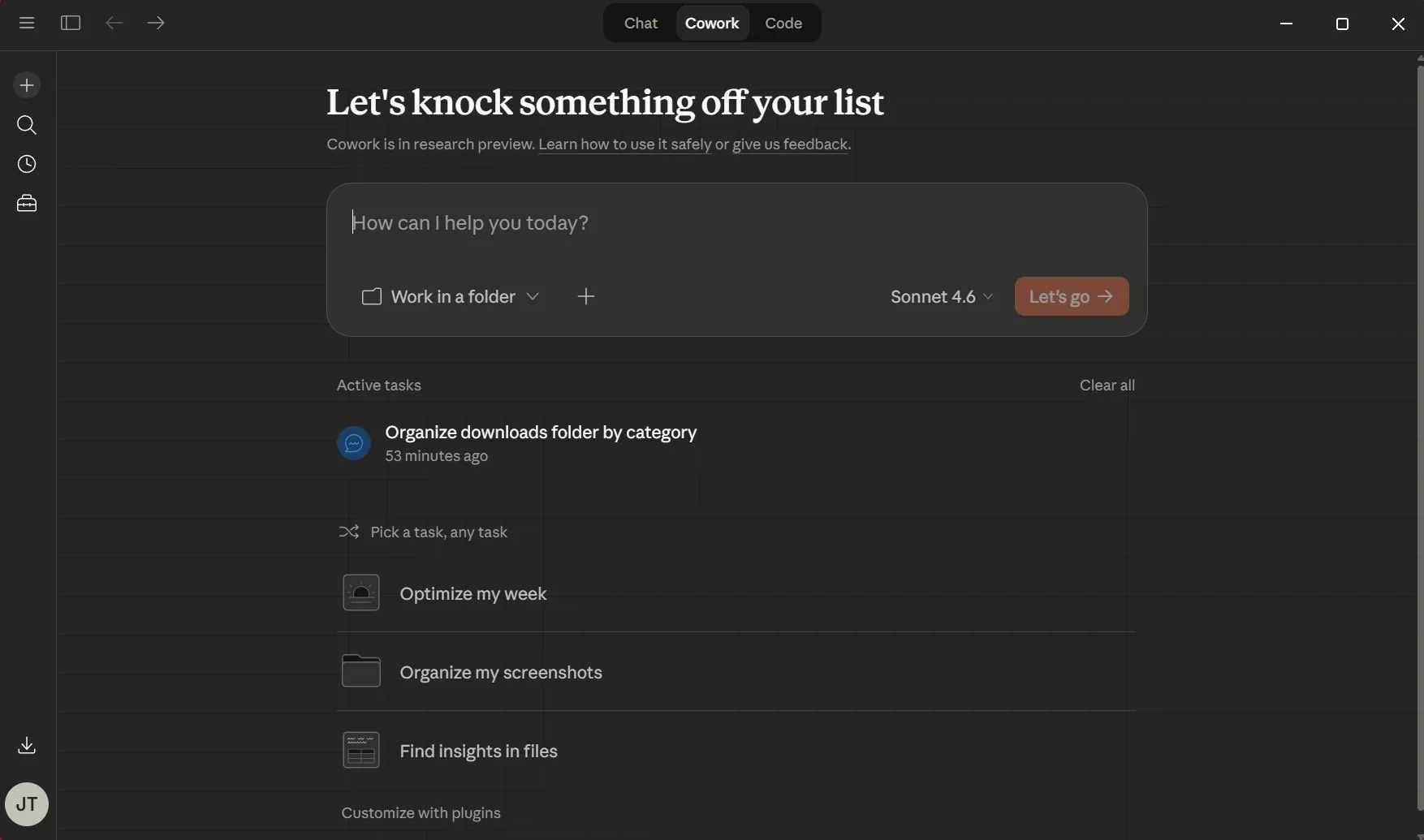
- Open the Cowork tab in Claude Desktop (alongside the existing Chat and Code tabs)
- Select a working folder — this is the only directory Claude can access
- Describe your task in natural language, being as specific as you can
- Review the execution plan — Claude presents what it intends to do before acting
- Get your results — output files appear in your designated folder
You can queue multiple tasks for parallel execution, and there’s a progress tracking interface that shows exactly what Claude is doing at each step. It’s not magic, but it’s genuinely useful for the kind of repetitive file-wrangling that most knowledge workers deal with daily.
When paired with Claude in Chrome, Cowork can also pull information from the web — verifying data, researching topics, and incorporating external content into whatever it’s building locally. This combination of local file access and web capability is where it starts to feel like more than just a fancy file manager.
The safety conversation (credit where it’s due)
Here’s something I want to highlight, because I think Anthropic handled this better than most.
In their launch announcement, they devoted considerable space to warning users about Cowork’s potential dangers. That’s unusual for a product launch. Most companies bury the caveats; Anthropic put them front and centre.
The safety model works in layers:
- Sandbox isolation: Cowork runs in a virtualised Linux environment on both macOS (via Apple’s Virtualization framework) and Windows, completely isolated from your main system
- Explicit folder permissions: You grant access per session — Claude can’t browse your file system freely
- Read-only by default: Write operations require explicit permission
- Deletion protection: Claude requires your explicit permission before permanently deleting any files
- Prompt injection detection: Built-in mitigations for the kind of adversarial content that can make AI agents go sideways
- Human-in-the-loop: Claude asks before taking significant actions
Is the sandboxing perfect? Hard to say definitively — the app isn’t open source, so independent security review is limited. Some users on Reddit have raised legitimate questions about this. My view: the approach is sensible and better than what most competitors offer, but if you’re handling genuinely sensitive data, the usual caution applies. Back up important files. Don’t point it at your credentials folder. Use a dedicated working directory.
The limitations (because there are always limitations)
So, what can’t Cowork do right now:
| Limitation | What it means |
|---|---|
| Desktop only | Requires the Claude Desktop app on macOS or Windows — not available on web or mobile |
| Windows requirements | Windows 10 v1909+ or Windows 11, x64 only (no ARM64 yet) |
| No memory between sessions | Doesn’t retain context from previous conversations |
| No cross-device sync | Work doesn’t follow you between machines |
| Higher token consumption | Uses significantly more quota than regular chat |
| No free trial | You commit to a paid plan before you can test Cowork |
Windows support landed on the 10th of February 2026 with full feature parity, which removed the biggest barrier for enterprise adoption. If you’re on Windows, make sure you’re running Claude Desktop v1.1.4328 or later — earlier versions had connectivity issues.
On pricing: Cowork is now included with all paid Claude plans. The Pro tier at $20/month (£16) gets you in the door with basic access, though you’ll hit usage limits fairly quickly on complex tasks. Realistically, the Max 5x plan at $100/month (£80) with roughly 225+ messages per five-hour window is the sweet spot for anyone using Cowork regularly. The Max 20x plan at $200/month (~£160) is there for power users running it throughout the working day. Usage operates on rolling five-hour windows rather than daily caps, so if you hit your limit at 2pm, you’re back in action around 7pm rather than waiting until midnight.
It’s worth noting there’s no free trial on any tier. You’re committing sight-unseen, which is a harder sell when Microsoft Copilot comes bundled with existing Microsoft 365 subscriptions. Although, to be fair, Cowork’s capabilities are more expansive than what Copilot offers in terms of autonomous file manipulation, having used both I can say that Cowork’s agentic execution is a different category of tool compared to the more assistive nature of Microsoft’s Copilot.
What was the enterprise play: connectors and plugins
This is where things get strategically interesting, and where the stock market started paying attention.
In late January, Anthropic launched Cowork as a research preview. That alone rattled software stocks. Then in early February, they announced enterprise connectors — integration with Google Drive, Gmail, DocuSign, FactSet, and others. They also rolled out customisable plugins across domains like financial analysis, engineering, and HR.
The message was clear, Anthropic isn’t just building a desktop tool for organising your downloads folder. They’re building a platform that can slot into existing enterprise workflows and potentially replace chunks of specialised SaaS software.
Matt Piccolella, Anthropic’s product officer, put it bluntly: “We believe that the future of work means everybody having their own custom agent.”
Now, Anthropic insists they’re building something complementary to existing enterprise software, not competitive. Scott White, their head of enterprise product, says the company is “building something complementary to work with existing software and tools.” They worked with companies like FactSet, S&P, LSEG, and Apollo for the initial plugins.
But the market’s reaction told a different story. The “Saaspocalypse” — the January selloff that wiped roughly £285 billion off tech stocks — happened because investors looked at what Cowork could do and asked: “Why would I pay for a specialised SaaS tool when an AI agent can do 80% of the same job for a fraction of the cost?”
That question isn’t going away.
Why should we care?
Great question (If I do say so myself). What does Claude Cowork mean for people reading this blog?
If you’re a software engineer or technical leader: Cowork itself probably isn’t your tool — you’ve likely already got Claude Code, GitHub Copilot, or similar in your workflow. But the pattern is important. The shift from “AI helps me write code” to “AI handles entire categories of non-coding work autonomously” is an interesting shift in the way we look at agentic AI. Think about the operational tasks your team does: documentation, report generation, data wrangling, file management. These are the tasks that agentic tools are going to absorb.
If you’re evaluating AI tools for your organisation: Cowork represents the next step beyond chatbots. This isn’t “ask a question, get an answer” — it’s “describe an outcome, let the agent work towards it.” The connectors and plugins add enterprise integration, and with both macOS and Windows now supported, the platform coverage is there. Weigh that against the remaining limitations: no memory between sessions, the lack of a free trial, and the inherent risks of giving an AI agent write access to your files.
If you’re in the SaaS business: The market reaction wasn’t irrational. If Anthropic (or any AI company) can deliver 80% of the functionality of a specialised tool at a fraction of the cost, the value proposition for niche SaaS products gets harder to defend. The SaaS companies that will weather this are the ones with deep domain expertise, regulatory compliance, or network effects that a general-purpose agent can’t replicate.
The bigger picture
What I find most interesting about Cowork isn’t the product itself, it’s what it represents in the trajectory of AI tools.
We’ve gone from text generation (ask a question, get an answer) to code generation (describe functionality, get code) to agentic execution (describe an outcome, the AI works towards it with real-world actions). Each step increases the autonomy and the surface area of impact.
I wrote about this progression in my vibe coding to agentic engineering piece earlier this year. Cowork is that same spectrum applied to knowledge work instead of software development. It’s the “directed AI assistance” to “agent orchestration” transition happening outside the terminal.
The fact that Anthropic built Cowork in roughly ten days using Claude Code is itself a statement about where we are. AI building AI tools. The cycle time from “interesting capability” to “shipping product” is compressing fast.
Whether that makes you excited or nervous probably depends on where you sit. Personally, I believe that you have to know when to adapt and change and swim with the tide of change in order to meaningfully arrive at the right destination, both personally and professionally. I am, impressed by the engineering, optimistic about the productivity gains, and as always, keeping a close eye on the security and privacy implications as these tools get more autonomous.
The reality check
Claude Cowork is a well-executed product that solves a real problem for people. It’s essentially the gap between what AI can advise and what it can do. The safety mitigations are better than average. The enterprise connectors show strategic ambition. The market impact has been significant.
But it’s still a research preview with no persistent memory, no free trial, and security properties that can’t be independently verified. It’s a tool that requires genuine trust in both the vendor and the technology. As consumers, leaders, engineers, and everyone in between, we need to approach it with a mix of curiosity and caution.
What to try if you have the mind to:
- If you’ve got a Claude Pro or Max subscription: Try it. Point it at a folder of messy files and see what happens. Start small, stay supervised, and see if the productivity gains justify the cost. The Pro tier at $20/month (~£16) is a low enough bar to experiment
- If you’re evaluating AI strategy for your team: Add Cowork to your radar alongside existing tools. It’s now on both macOS and Windows, so platform coverage shouldn’t be a blocker. The enterprise connectors are the bit to watch — that’s where the real competitive pressure will come from
- If you’re building SaaS products: Have an honest conversation about which parts of your value proposition an AI agent could replicate, and which parts require domain depth that general-purpose tools can’t match
- If you’re on Windows: Make sure you’re on Claude Desktop v1.1.4328 or later and give it a go — full feature parity with macOS landed in February so you now have the chance to test it out without needing a Mac
The agentic AI wave I flagged at the start of the year is materialising faster than I expected. Cowork is just one product from one company, but the pattern it represents — AI that acts, not just advises — is going to reshape how knowledge work gets done. Whether that takes months or years, the direction of travel is, in my opinion, clearer than ever.
As always, cut through the hype, focus on what’s actually shipping, and make decisions based on what you can test today rather than what someone promises for tomorrow.


